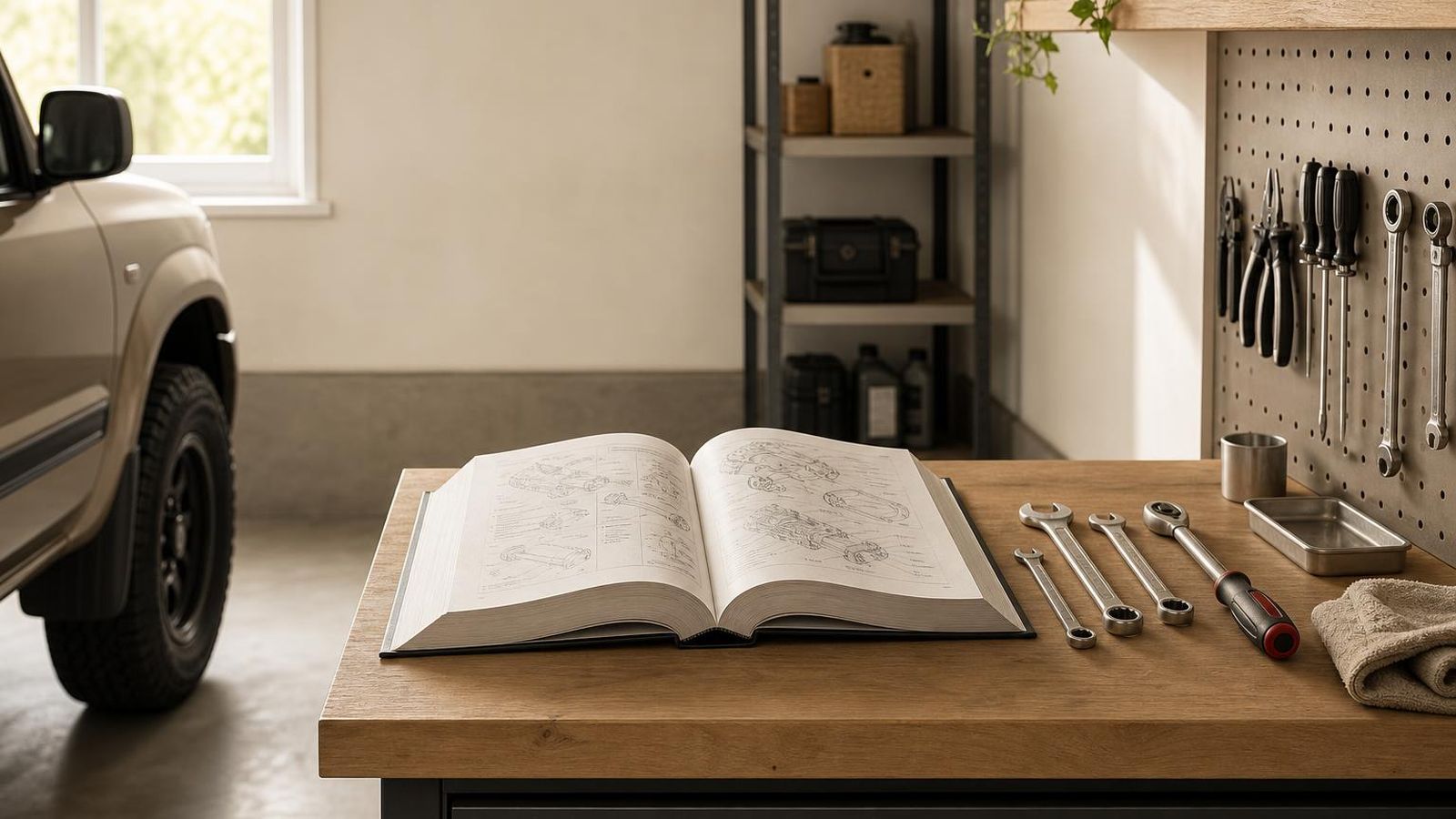
Auto community
The most useful vehicle resource pages are written by people who own the vehicle. They include part numbers, torque values, the size of the spanner that actually fits, and the order the bolts should come out. They do not pretend the work is glamorous. They are the pages owners keep coming back to.
This section gathers practical notes from the Freelander page, its drivetrain coupling notes, the parts and workshop page, the Motokurier transport notes, and the vehicle paperwork glossary at cartax.se-ua.net.
Working on your own vehicle
Two principles cover most of it:
- Confirm before you commit. Identify the bolt size, the torque, the sealant, and the order before you reach for a tool.
- Stop at the first thing that does not match. A bolt that turns more than expected, a hose that is wetter than expected, a noise that is louder than expected - these are information, not nuisance.
A clean workspace, a known-good torque wrench, and a documented work order will save more vehicles than expensive tools will.
Drivetrain literacy
Drivetrain problems sound dramatic but usually trace back to a small number of components: couplings, mounts, fluids, sensors. The Freelander coupling notes cover the practical end of one of those.
A short rule that helps: noises that change with road speed are usually wheels, hubs or driveshafts. Noises that change with engine speed are usually the engine, ancillaries, or mounts. Noises that change with gear selection are usually the gearbox or its linkage.
Documentation habits
The owners who get the most value from their workshop time keep a short notebook: date, mileage, what was done, which parts went in, and any oddity to watch. A page in a notebook costs nothing. The next owner of the vehicle - or you in three years - will thank the present-day version of you.
Clubs and shared knowledge
A small club, formal or informal, is the cheapest mechanic in the area. The collective memory of "we tried that, it does not work" prevents weekends being wasted. A page worth bookmarking is one that links to the active threads, not one that tries to reproduce the threads.
Paperwork
The administrative side of vehicle ownership - registration, tax, insurance, technical inspection - is its own short education. A glossary page like the cartax notes is more useful than a comprehensive guide, because the rules change locally and a glossary ages slowly.
Common mistakes
- guessing torque
- skipping the new gasket
- reusing a stretch bolt
- assuming a sensor is faulty before checking its wiring
- topping up the wrong fluid
Where to go next
- Freelander main page
- Freelander drivetrain coupling notes
- Freelander parts and workshop
- Motokurier
- Vehicle paperwork glossary
- Rust protection and surface prep notes
- Camera and steadicam rig notes
Two-minute checklist
- Identify the bolt and torque before you reach for it.
- Confirm the fluid before topping up.
- Note the symptom precisely before changing parts.
- Keep a short service notebook.
- Stop and confirm at the first unexpected sign.